
5 Eye-Opening Takeaways From Malaysia’s Shift in Recruiting Nepali Foreign Workers
10/12/2026
1. Introduction
International labor migration represents a critical nexus of global economic policy, human rights, and cross-border governance. When governments move to modernize administrative infrastructure, digital overhauls often collide directly with delicate geopolitical balances. Centralized platforms are no longer merely administrative software; they function as active instruments of state policy where centralized code redefines foreign market access and strains sovereign bilateral agreements. A prime example of this tension is unfolding between Malaysia and Nepal, following Malaysia’s announcement of an official transition to a new recruitment framework for Nepali workers, scheduled for full implementation on November 5, 2026.
At the center of this shift is the Foreign Worker Centralised Management System (FWCMS), operated by technical vendor Bestinet Sdn. Bhd. on behalf of the Malaysian government. Designed to centralize foreign worker processing, the updated framework introduces streamlined administrative deadlines and structural consolidation. However, the move has triggered intense diplomatic pushback from Nepal, creating an acute rift between unilateral technical modernization and bilateral labor agreements. As both nations navigate this administrative realignment, the transition highlights the complex challenges of managing cross-border labor through digital architecture. Here are 5 key takeaways explaining the ongoing transition and its broader structural implications.
2. Takeaway 1: A High-Stakes Diplomatic Standoff (Malaysia Drives Ahead Despite Nepal's Objections)
The political friction surrounding Malaysia’s new recruitment scheme highlights a fundamental diplomatic rift that has escalated to the Prime Ministerial level. Malaysia is driving forward with the transition based on a formal Cabinet decision, implementing the new framework under the Foreign Worker Centralised Management System (FWCMS). However, the Nepalese government has actively resisted this unilateral push, issuing a formal diplomatic note objecting to the integration of Nepali manpower agencies into the software platform.
From Nepal's perspective, Malaysia's move bypasses the existing bilateral Memorandum of Understanding (MoU) between the two nations, establishing a market structure that restricts fair competition among recruitment firms. Conversely, Malaysia treats the framework as an executed administrative policy within its sovereign jurisdiction. This resistance is not merely symbolic; Nepal's formal objections underscore a growing resistance against foreign digital systems dictating domestic labor participation.
Nepal's official position underscores its uncompromising stance regarding fair market competition and sovereign agreements:
"Nepal has maintained that any action leading to a monopoly or undermining fair competition is unacceptable and that recruitment should proceed in accordance with the labour agreement between the two countries."
3. Takeaway 2: The '25 PRAs' Consolidation Squeezes the Recruitment Pipeline
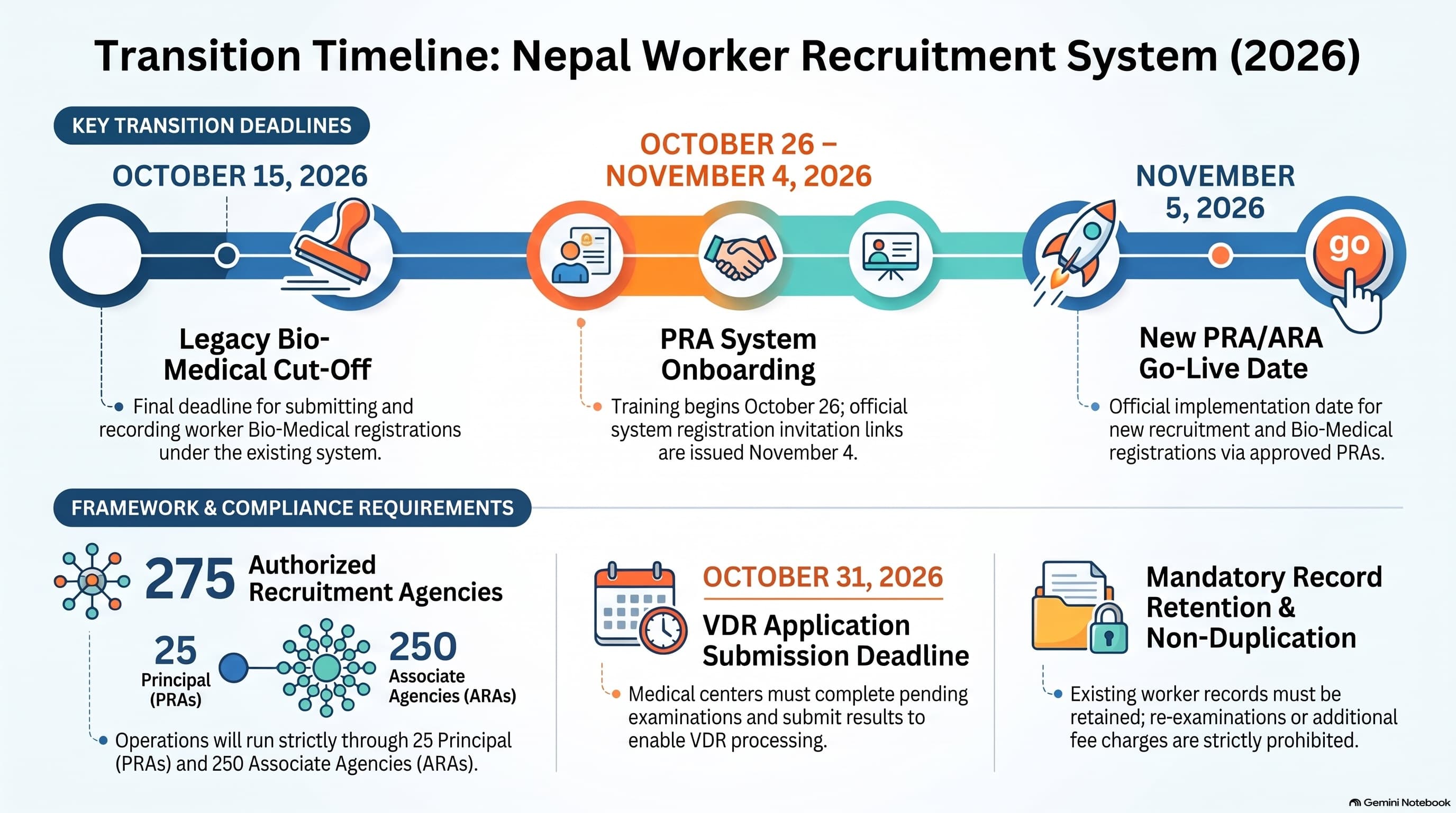
Under the updated FWCMS framework, the recruitment pipeline for Nepali workers will undergo a severe structural consolidation. Instead of permitting open participation across all licensed manpower agencies, recruitment will now be strictly funneled through 25 Principal Recruitment Agencies (PRAs) working alongside 250 affiliated Associate Recruitment Agencies (ARAs), establishing a restricted network of 275 recognized entities.
This centralized bottleneck has triggered immediate state-level intervention in Kathmandu. Reacting to the perceived market exclusion, Nepal formally asked Malaysia to remove the 25 foreign employment firms from the recruitment system. Concurrently, the Nepalese government launched official investigations into the 25 chosen agencies while demanding formal explanations from the 250 affiliated ARAs.
This systemic bottleneck demonstrates how digital centralisation functions as a gatekeeper, reallocating market share via software architecture rather than treaty negotiations. The resulting friction has created deep institutional fractures within Nepal's foreign employment sector, threatening to split the national foreign employment agencies' association.
4. Takeaway 3: A Tight, Multi-Stage Pipeline of Critical Cut-off Dates
To execute the transition to the PRA/ARA model, Bestinet Sdn. Bhd. issued an official memorandum (BSB-OPS-MM-NPL-11-V1.0) under the explicit authorization of Malaysian Ministry of Human Resources reference letter KSM/DP/(S)13/63 JLD.13 (46). Issued on October 6, 2026, the memorandum imposed an aggressive schedule leading to full rollout:
Date
Key Administrative Deadline / Activity
October 15, 2026
Final cut-off dateline for Bio-Medical registrations under existing arrangements.
October 26, 2026
PRA System Registration and Account Activation Training (covering document prep & procedures).
October 31, 2026
Deadline for submitting pending medical results to proceed with Visa With Reference (VDR) applications.
November 4, 2026
Official links issued for PRA registration invitations and system account activation.
November 5, 2026
Full implementation of new PRA/ARA recruitment system and start of new Bio-Medical registrations.
This timeline creates extreme operational pressure across the supply chain. Notably, the October 6 release date gave Medical Centres (MCs) and Recruitment Agents (RAs) a razor-thin 9-day grace period before the October 15 cutoff for initial biomedical registrations under legacy rules. Furthermore, the October 31 deadline serves as a hard cutoff for medical facilities to submit all pending laboratory and biometric results; missing this window prevents eligible workers from securing Visa With Reference (VDR) approvals before legacy system access terminates on November 5.
5. Takeaway 4: Built-in Safeguards Against Worker Exploitation (On Paper)
Recognizing that administrative migrations frequently expose vulnerable migrant workers to financial extortion and bureaucratic churn, Bestinet's directive mandated explicit protective safeguards for Medical Centres and recruitment agencies:
Preserve Worker Records: Retain existing worker files and medical data within FWCMS without generating duplicate entries.
Prohibit Redundant Fees & Retests: Strictly forbid requiring workers to undergo repeat medical examinations or pay additional fees solely due to the administrative transition.
Strict Adherence to Instructions: Mandate that any worker transfers or re-registrations proceed exclusively under confirmed, official transition guidelines.
While these provisions directly address a persistent systemic vulnerability where workers are routinely forced to shoulder duplicate processing fees during administrative realignments their practical efficacy remains questionable. Enforcing technical safeguards across 275 commercial agencies in a cross-border environment, without the formal diplomatic endorsement or regulatory cooperation of the source country, creates severe compliance loopholes that risk leaving workers exposed.
6. Takeaway 5: Bestinet Scopes Its Role to Technical Operator, Not Government Approver
Throughout the operational deployment, technical contractor Bestinet Sdn. Bhd. under the sign-off of Group Chief Operating Officer Noremi Binti Md Shaari has maintained strict boundaries regarding its corporate responsibility. Operating under Ministry reference KSM/DP/(S)13/63 JLD.13 (46), Bestinet clarified that while it maintains, operates, and provides technical support for FWCMS, it holds no sovereign or regulatory power.
From a tech policy perspective, this distinction reflects a common dynamic among private vendors managing critical public infrastructure: framing their role as purely technical allows them to insulate themselves from political and diplomatic fallout. Bestinet explicitly reinforced that account creation within its digital portal does not constitute state authorization:
"Approval or recognition of recruitment agencies and decisions on VDR applications remain with the relevant government authorities. System registration or account activation does not constitute approval or appointment by Bestinet."
By asserting that system access is distinct from state licensing, Bestinet attempts to operate as a neutral infrastructure provider, even as its platform actively enforces the administrative restructuring driving the geopolitical conflict.
7. Conclusion & Looking Ahead
Malaysia's move to overhaul foreign worker recruitment through a centralized digital system demonstrates the growing influence of administrative technology in international labor management. However, as the November 5 implementation deadline approaches, unresolved diplomatic pushback from Nepal escalated to the highest levels of government leaves the operational future of this vital labor corridor in delicate balance. While Malaysia’s technical transition remains on track, Nepal’s objections concerning market consolidation, digital monopolies, and bilateral treaty breaches create ongoing risk for employers, agencies, and workers alike.
As sovereign states increasingly rely on centralized platforms to regulate international labor supply chains, this transition serves as a critical policy benchmark. Can digital centralized platforms truly streamline international labor recruitment, or do they risk creating digital monopolies that strain fragile bilateral relations?