
Beyond EPS: 4 Major Shifts in South Korea’s New E-7 Visa for Nepalese Workers
8/7/2026
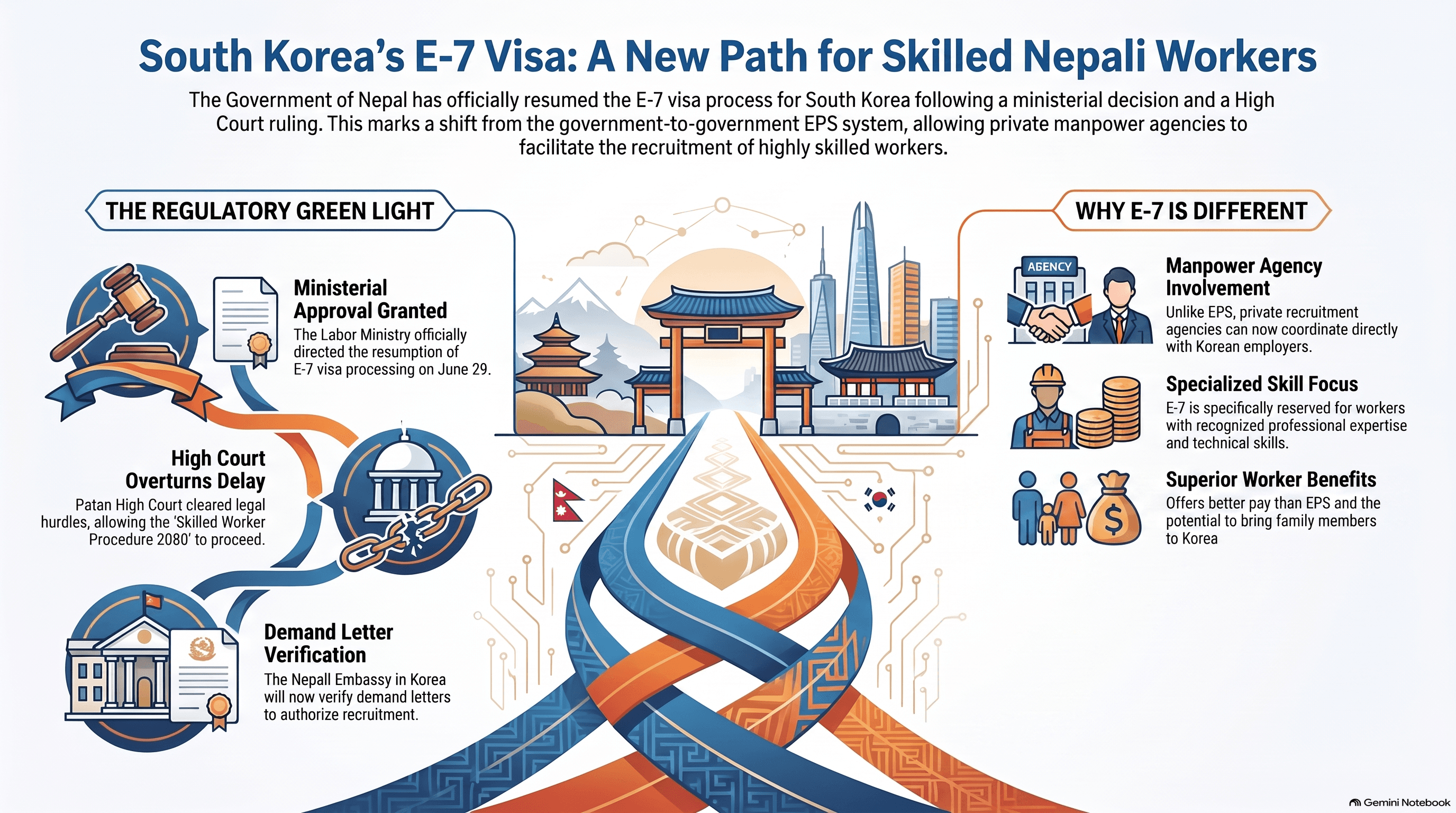
For over a decade, the path to South Korea for Nepalese workers has been a narrow, state-controlled corridor. While the Employment Permit System (EPS) provided a lifeline for many, it often felt like a restrictive lottery a transient labor scheme with little room for long-term professional growth or family stability. However, as of Asar 19, 2083, a seismic shift has been confirmed. The reactivation of the E-7 visa process isn't just an administrative update; it is a breakthrough that promises to transform the "migrant worker" experience into a "resident professional" lifestyle.
1. The End of the Government-Only Monopoly
For more than ten years, the Government-to-Government (G2G) model under the EPS system held a total monopoly over the South Korean labor market for Nepalese citizens. This era of absolute state control has officially ended. Under the "Skilled Worker Procedure 2080," the private sector has finally been granted entry.
The Shift to Public-Private Partnership: In a surprising reversal of long-standing policy, private-sector manpower agencies are now authorized to coordinate directly with Korean employers. This transition acknowledges that the bureaucratic machinery of the state alone cannot meet the nuanced demands of Korea’s specialized industries. For the first time, the agility of the private sector will be leveraged to match skilled Nepalese talent with premium Korean opportunities.
2. The Legal Battle That Forced the Government’s Hand
The road to this "procedural awakening" was paved in the courtroom, not the cabinet. On Asar 15, the Ministry of Labour finally issued the ministerial decision to reopen E-7 processing, but only after a prolonged legal tug-of-war.
Previous leadership within the Ministry had stalled the E-7 rollout for years, fearing that a parallel "skilled" track would cannibalize or complicate the existing EPS system. This obstruction was ultimately quashed by the Patan High Court. The court’s intervention acted as the critical catalyst, compelling the government to prioritize the legal rights of skilled workers over bureaucratic hesitation.
"We have directed to move this process forward according to the prevailing acts, laws, rules, the order of the court and the procedure." Pitambar Ghimire, Ministry Spokesperson
3. The E-7 Lifestyle: From Laborer to Resident Professional
The most profound shift lies in how a worker is viewed. While the EPS is designed for general labor, the E-7 visa targets the dakhsa (skilled) professional. This isn't just a different visa category; it is a "premium" migration path that offers a lifestyle transformation previously out of reach for the average worker.
The Contrast in Benefits:
Family Relocation: In a landmark departure from EPS rules, E-7 holders have the legal right to bring their families to South Korea, turning a lonely stint of labor into a shared household experience.
Resident Status: The visa facilitates a transition from a transient, temporary worker to a professional resident with significantly higher social and workplace standing.
Superior Facilities: Skilled workers under the E-7 category are guaranteed enhanced service standards and workplace facilities compared to general labor sectors.
4. Not a New Law, But a "Procedural Awakening"
It is a common misconception that the government has passed a new law. In reality, the legal framework for E-7 migration has existed for some time, buried under layers of "procedural ambiguity." This recent move is a clarification a bureaucratic waking-up.
To turn this vision into reality, the Ministry of Labour has already instructed the Ministry of Foreign Affairs and the Nepali Embassy in Seoul to begin the vital work of verifying demand letters. This pipeline is the "how" behind the "why," ensuring that the transition from policy to actual employment is seamless and verified.
“This is not so much a new decision as it is a clarification of the existing law and procedure... all confusion has been removed.” Pitambar Ghimire, Ministry Spokesperson
Conclusion & Forward-Looking Thought
The reactivation of the E-7 visa opens a prestigious new door for thousands of skilled Nepalese youth who have spent years honing their crafts. By breaking the G2G monopoly and adhering to judicial mandates, Nepal is finally aligning its migration policy with the global demand for high-value talent.
As we witness this shift toward "skilled" migration and the promise of family relocation, we must ask: will this move from transient labor toward professional residency eventually redefine Nepal’s economic reliance on foreign remittances, or will it simply create a more sophisticated version of the status quo?