
The Hidden Cost of a Dream: Is a New "Syndicate" Taking Over Malaysia’s Job Market?
8/7/2026
For thousands of Nepali families, the labor migration route to Malaysia is more than a geographic journey; it is a vital economic lifeline. As the market fully reopens following years of closure and partial restrictions, there was a collective hope for a transparent, worker-centric era of employment. However, a dark cloud of controversy has emerged. Allegations of "syndicates" and "policy manipulation" are once again surfacing, threatening to transform the hard-earned dream of overseas employment into a nightmare of systemic debt and exploitation.
The Ghost of the Syndicate: A Costly History Repeating Itself
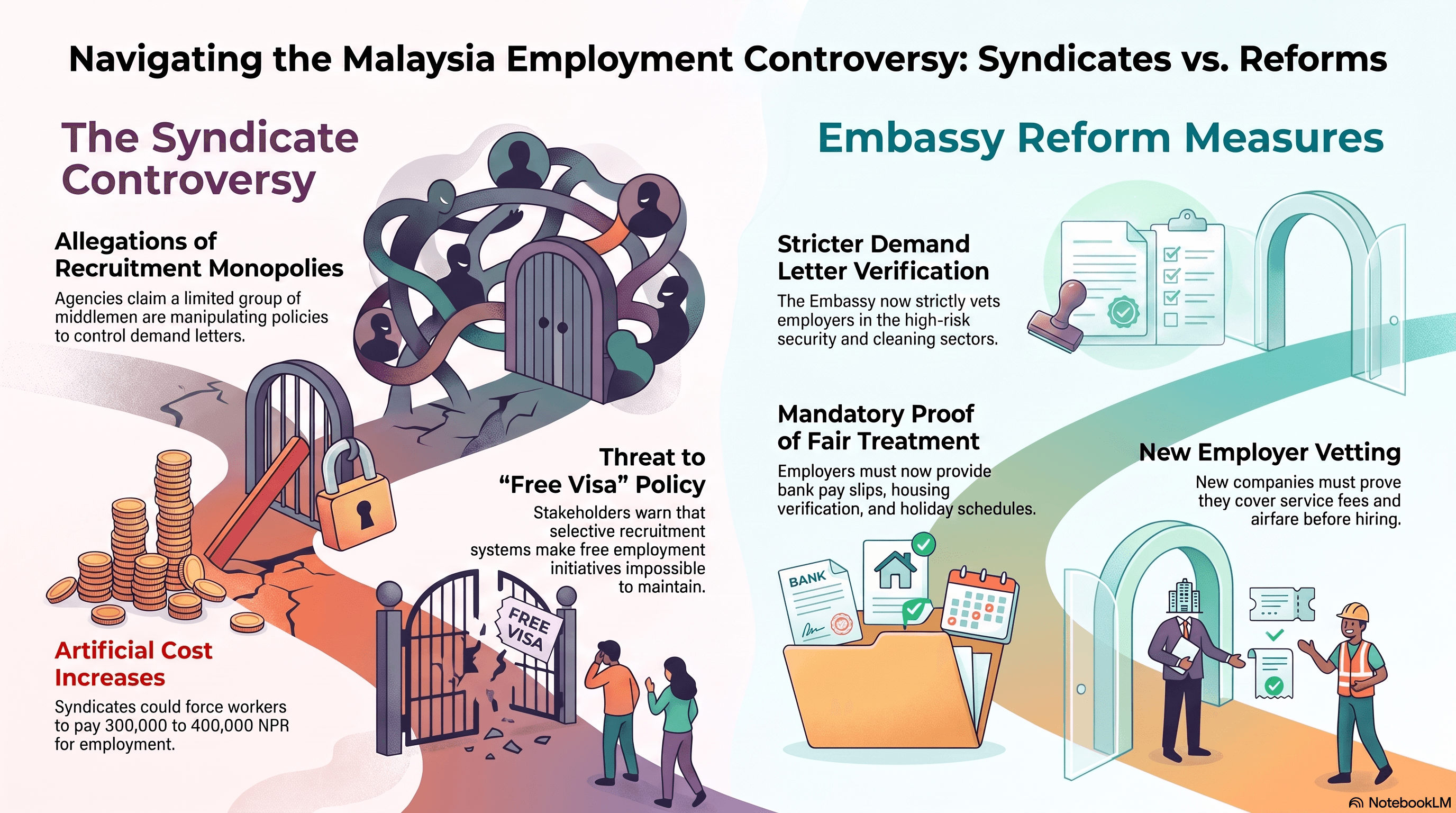
The Nepal Association of Foreign Employment Agencies (NAFEA) has raised a formal alarm regarding what they describe as the "fourth attempt" to establish a monopoly over the Malaysia route. This isn't merely a market fluctuation; it is a calculated effort by a limited group of manpower agencies and middlemen to use political influence to hijack the recruitment process.
This fear is rooted in a bitter history of administrative extortion. Stakeholders vividly recall the Biometric, VLN, and OSC systems layers of bureaucracy that served little purpose other than to extract billions of rupees in illegal fees from vulnerable workers. When a syndicate takes over, healthy competition which naturally drives down costs and provides workers with a choice of reputable employers is extinguished. Instead, power is concentrated in the hands of a few gatekeepers. According to NAFEA, the current manipulation involves sophisticated political lobbying, with middlemen targeting the highest levels of government to secure exclusive rights.
"We have received information that a certain group is active in such manipulations," stated NAFEA Chairman Dik Bahadur Khatri. "They have reached the secretariat of the Minister for Youth, Labour and Employment to create a selective system for sending demand letters to specific manpower companies. This is unacceptable to us."
The Price of Monopoly: 400,000 Rupees for a "Free" Ticket
The gap between the government’s public relations and the on-the-ground reality is widening into a chasm. While the state continues to promote its "Free Visa, Free Ticket" slogan, NAFEA warns that a successful monopoly would render this policy a total fiction.
If this selective system is allowed to take root, the data suggests a grim financial future for migrants: costs could skyrocket to 3–4 lakhs (300,000 to 400,000 NPR) per worker. This "artificial inflation" is the direct result of middlemen extracting high premiums for access to the limited number of licensed agencies. For the average Nepali worker, this transforms migration into a debt trap, where the first several years of foreign labor are spent merely servicing high-interest loans rather than supporting family back home.
The Ministry’s Denial vs. The Industry’s Alarm
The Ministry of Labour, Employment, and Social Security has taken a strictly defensive stance. Ministry Spokesperson Pitamber Ghimire has dismissed the syndicate claims as "rumors," asserting that the Ministry has no selective system in preparation and is not adding specific companies to any preferred list. He has urged the industry not to be swayed by unverified information.
However, the friction between the two sides is grounded in more than just hearsay. While the Ministry labels the concerns "just rumors," the Manpower Association points to physical evidence: the reported issuance of notices and information for selecting specific manpower companies already circulating within the industry. This creates a disturbing narrative where the Ministry claims total ignorance of a process that the industry believes is already in motion.
A New Era of Accountability? The Embassy’s "Reformist" Counter-Move
Amidst the fears of a returning monopoly, the Nepali Embassy in Malaysia has initiated a significant policy shift. Recognizing that "paper processing" is easily manipulated and frequently forged, the Embassy has moved toward a rigorous auditing model for demand letter verification, particularly in the high-risk security guard and cleaning sectors.
To ensure that Malaysian employers are adhering to labor laws, the Embassy now requires concrete evidence before certifying new labor demands:
Past Treatment Records: Verification of the employer's history regarding worker welfare.
Bank-Mediated Pay Slips: Mandatory proof that salaries are paid via bank transfers, specifically targeting the predatory practice of cash payments that allow employers to underpay workers.
Living Conditions: Physical or documentary verification of weekly holidays and the quality of housing provided.
Cost Coverage: Explicit evidence for new employers that they are covering airfare and service fees, upholding the "Free Visa, Free Ticket" mandate.
This transition from checking boxes to auditing bank records is a vital technological and policy shift. By requiring bank-mediated pay slips, the Embassy makes it significantly harder for employers to bypass minimum wage laws, offering a rare layer of protection in an often lawless recruitment landscape.
The Conclusion: A Thought-Provoking Horizon
The Nepal-Malaysia labor route currently stands at a crossroads. On one side lies the threat of a "fourth attempt" at a syndicate a system designed to turn human labor into a high-margin commodity for a select few businessmen and their political allies. On the other side is the hope of stricter oversight and the embassy’s move toward genuine accountability.
The fragility of labor rights is most apparent when policy meets profit. As the demand for foreign labor continues to grow, the primary question for regulators remains: In the race to fill labor demands abroad, will we prioritize the protection of our workers, or will we allow the "syndicate" to become the gatekeeper of their future?