
Why Nepal is Risking a Labor Crisis to Fight a Foreign "Syndicate": 5 Key Takeaways
9/13/2026
Foreign employment is the lifeblood of Nepal’s economy, a vital release valve for a domestic labor market that cannot yet absorb its youth. Yet, a high-stakes diplomatic standoff has brought recruitment for one of its most popular destinations Malaysia to a grinding halt. The Nepali government has taken the extraordinary step of freezing labor approvals, effectively declaring war on a recruitment hierarchy it characterizes as a foreign-imposed "syndicate."
This is not merely an administrative disagreement; it is a battle for national sovereignty. Nepal is refusing to allow its private sector to be carved into a cartel-like structure dictated by a foreign power. For the Global Labor Analyst, this crisis serves as a litmus test for whether labor-sending nations can maintain legal integrity when faced with the immense economic pressure of a "pipeline" of thousands of jobs.
1. The FWCMS Bottleneck: A Hierarchy of Monopoly
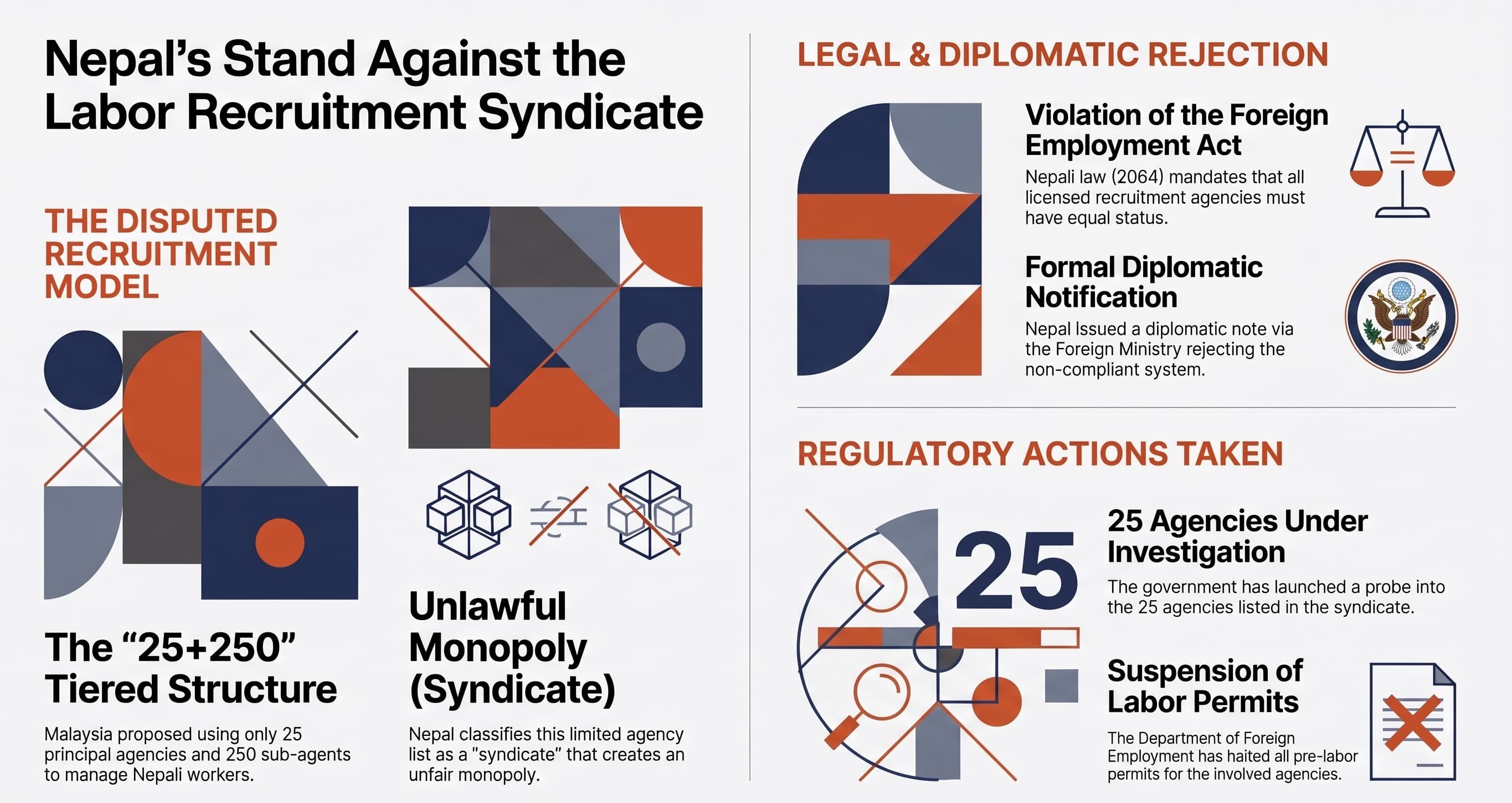
The catalyst for this crisis is Malaysia’s Foreign Worker Centralized Management System (FWCMS). Under this framework, Malaysia attempted to bypass Nepal’s existing recruitment landscape by designating only 25 "Registered Recruitment Agencies" as "Principal Agencies."
These select 25 firms were granted the exclusive power to secure job demands from Malaysian employers and process workers. To quell local backlash, Malaysia later proposed adding 250 "Support Agencies" to operate under the original 25. However, Kathmandu saw through this cosmetic expansion. The Ministry of Youth, Labour and Employment views this "Principal and Support" split as an extreme concentration of power a bottleneck that turns 250 businesses into subservient sub-agents of a privileged few. By centralizing the right to secure job demands, the system creates a corporate hierarchy that Nepal refuses to recognize.
2. Legal Equality: Why the 2064 Act Rejects a "Hierarchy"
Nepal’s refusal is grounded in a fundamental legal impossibility. Under the Foreign Employment Act, 2064, and the Nepali Constitution, all licensed foreign employment agencies are granted equal status. The law does not permit a tiered system where some agencies are "Principal" and others are "Support."
Ministry Spokesperson Mira Acharya has been clear that the government cannot legally sanction a system that discriminates between its own licensed businesses. As the Ministry maintains:
"Nepal's Constitution and existing legal arrangements do not allow for a monopoly... the law provides equal status to all licensed foreign employment business organizations."
From an analyst’s perspective, accepting Malaysia’s terms would require Nepal to rewrite its domestic labor laws to accommodate a foreign commercial interest a concession the Ministry has deemed unacceptable.
3. The "Selected Few" Under Fire: Minister Yadav’s Crackdown
The domestic repercussions for the 25 agencies initially listed in the Malaysian system have been swift and severe. Labor Minister Ramji Yadav signaled the government's resolve by summoning the acting Malaysian ambassador to demand an explanation for this unilateral move.
Simultaneously, the Department of Foreign Employment has frozen "pre-labor approvals" for the 25 firms in question and launched a formal investigation into how they were selected. The pressure was so intense that the 25 agencies themselves reached a consensus to request the removal of their names from the FWCMS system. They realized that the "syndicate" label carried too much legal and political heat to ignore, choosing to align with the Ministry rather than risk being dismantled by state regulators.
4. The Breach of the 2018 Accord: A Diplomatic Breakdown
Nepal views the implementation of this tiered system as a flagrant violation of the 2018 bilateral labor agreement. The "Principal and Support Agency" structure was never a part of the original treaty; it was a unilateral imposition by Kuala Lumpur that bypassed established diplomatic channels.
The speed of Nepal's response underscores the gravity of the perceived insult. Within one or two days of receiving Malaysia’s proposal, the Ministry of Foreign Affairs dispatched a formal diplomatic note rejecting the system. Despite this decisive action, the Malaysian government has yet to respond, leaving thousands of potential workers in a state of limbo. By acting outside the bounds of the Joint Technical Committee and bilateral mechanisms, Malaysia has effectively stalled its own labor supply chain.
5. The $30,000-Worker Dilemma: Sovereignty vs. Employment
The most impactful data point in this standoff is the "pipeline": between 25,000 and 30,000 Nepali workers are currently stuck in the middle of the recruitment process. The government is performing a delicate, high-stakes balancing act: it is essentially holding its most valuable export labor hostage to protect the integrity of its legal framework.
While critics argue the government is hurting its own citizens by blocking these jobs, the Ministry’s stance is that a temporary job crisis is preferable to a permanent surrender of legal sovereignty. As Ministry Spokesperson Mira Acharya and other officials have signaled:
"Our objective is not to stop employment in Malaysia... but Nepal is not compelled to accept a monopoly just for the sake of employment."
Conclusion: The Future of Fair Labor
The deadlock between Kathmandu and Kuala Lumpur is about more than just software or "support agencies." It is a fundamental disagreement over who controls the labor market. By standing against the "syndicate," Nepal is asserting that labor migration must be governed by the rule of law and mutual respect for bilateral treaties, rather than restrictive commercial monopolies that favor a select few.
As the standoff continues, it leaves us with a critical question: In the global race for labor and remittances, should a country prioritize the immediate volume of jobs for its citizens, or the long-term protection and legal integrity of its recruitment systems?