
Exposing the Bilateral Extortion Machine: 5 Unsettling Truths Behind Nepal’s Multibillion-Rupee Foreign Employment Scam
11/27/2026
1. Introduction: The High Human Cost of Working Abroad
For hundreds of thousands of Nepalese workers, securing foreign employment in Malaysia represents a crucial lifeline a chance to pull families out of intergenerational poverty, build secure homes, and fund educational opportunities for their children. Every year, aspiring laborers endure immense personal and economic sacrifices before even stepping onto an airplane. They mortgage ancestral land, liquidate modest family assets, and take on high-interest loans from local moneylenders just to cover initial recruitment costs, visa clearances, and mandatory health check-ups.
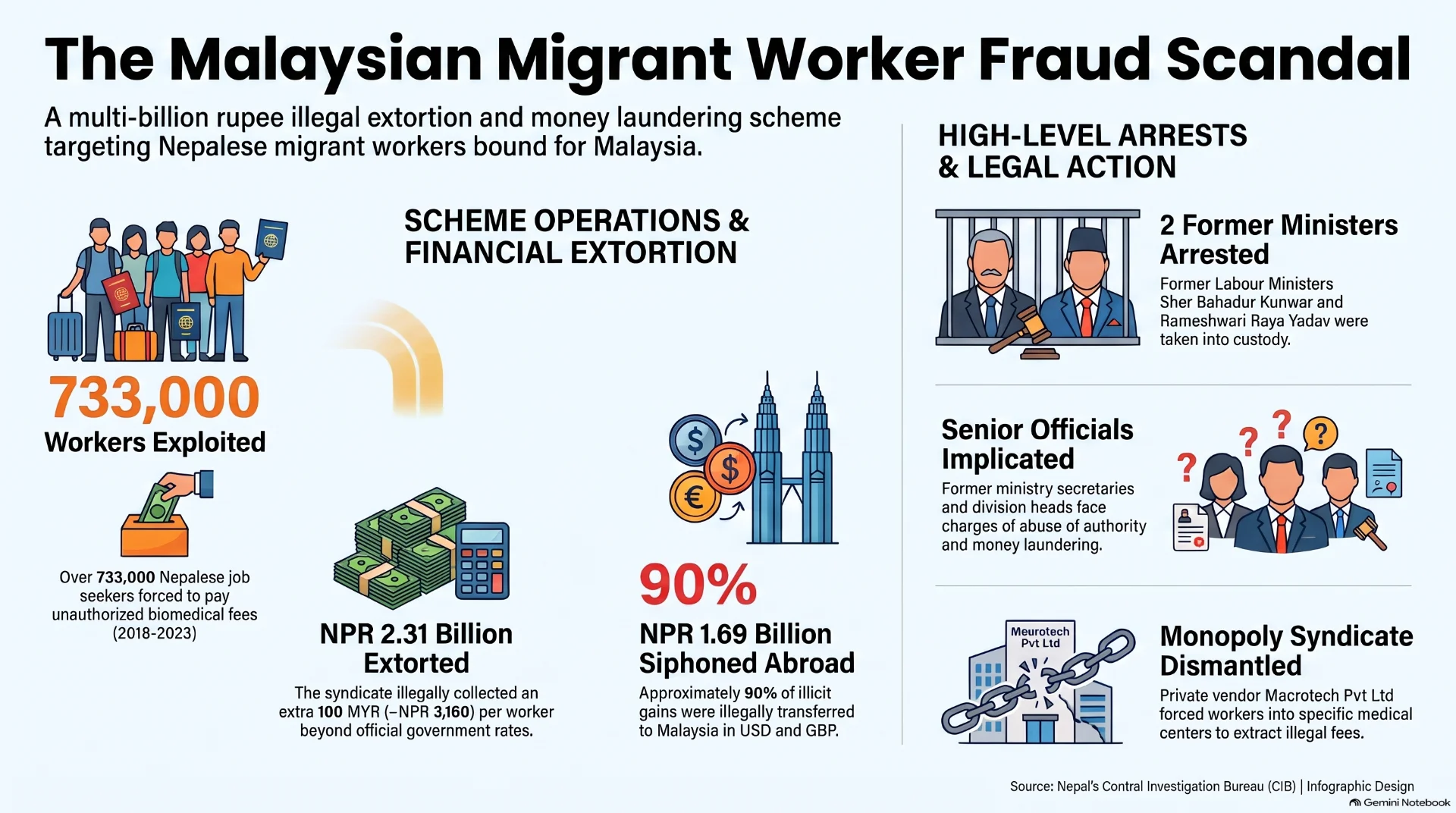
Yet, behind this aspirational migration lies a predatory institutional architecture designed to drain the financial capital of Nepal's most vulnerable citizens at the very start of their journey. A landmark investigation by the Nepal Police’s Central Investigation Bureau (CIB) has pulled back the curtain on a massive, highly organized fraudulent scheme that illegally siphoned over NPR 2.31 billion from overseas job seekers. Disguised as an obligatory, specialized "biomedical health screening," the operation functioned as an unauthorized tollgate, systematically extracting capital from low-income workers and transferring it directly into private offshore corporate accounts.
This investigation exposes how political patronage, corporate insider capture, regulatory complicity, and illicit capital flight converged to turn state labor governance into an engine of private gain. Below are the five most unsettling takeaways from the CIB’s ongoing prosecution, analyzing how this bilateral extortion machine operated and why its unraveling represents a critical turning point for South Asian labor policy.
2. Takeaway 1: State Power Was Directly Weaponized to Support Organized Crime
The CIB’s evidence reveals a stark institutional reality: high-ranking state officials did not merely fail to stop the extortion; key political and administrative leaders actively orchestrated, institutionalized, and shielded the illegal operation. Executed in direct violation of the bilateral Memorandum of Understanding (MoU) signed between the governments of Nepal and Malaysia, executive authority was weaponized to establish and protect an exclusive criminal syndicate.
The primary objective of the Nepal-Malaysia bilateral labor MoU was to streamline recruitment workflows, enforce government-to-government transparency, and minimize worker-borne costs by eliminating unapproved third-party intermediaries. Instead, executive leaders abused their authority to grant unauthorized mandates to a private third-party corporate entity, allowing unapproved fees to be collected outside formal bilateral protocols.
The scope of executive complicity reaches the highest echelons of Nepal’s labor administration. Key political and administrative figures formally arrested by the CIB include:
Sher Bahadur Kunwar — Former Minister for Labor, Employment, and Social Security
Rameshwore Raya Yadav — Former Minister for Labor, Employment, and Social Security
Binod KC — Former Labor Secretary
Umesh Dhungana — Former Joint Secretary (Employment Management Division)
Rajiv Pokharel — Former Joint Secretary (Employment Management Division)
Nirmala Gurung — Former Under Secretary (Legal Officer)
Instead of serving as regulatory guardians of vulnerable citizens, these officials exceeded their legal jurisdiction to enable unauthorized foreign currency transfers and protect a private cartel from executive and judicial oversight. By abusing state mechanisms to advance the financial interests of an organized network, executive leadership systematically compromised national labor governance and inflicted direct harm on Nepal's macroeconomic stability.
"In direct violation of the bilateral MoU and legal frameworks, state officials exceeded their jurisdiction to enable illegal foreign currency transfers, abusing their positions to benefit an organized criminal network while inflicting severe harm on the national economy."
3. Takeaway 2: Extortion at Scale 733,000 Vulnerable Migrants Paid the Price
The financial drain on aspiring migrants was executed systematically over a five-year period, spanning from late 2075 BS to 2080 BS. During this window, the syndicate transformed routine medical clearances into an unavoidable, monopolistic extraction scheme.
The Quantitative Scope of the Five-Year Extortion Scheme
Impacted Labor Migrants: 733,000 Nepalese workers
Government-Mandated Base Fee: NPR 4,500 (for standard medical check-ups)
Mandated Illegal Extra Fee: 100 Malaysian Ringgit (MYR) per worker (approx. NPR 3,160 at contemporary exchange rates)
Total Illicit Wealth Extracted: NPR 2,31,62,80,000 (NPR 2.31+ Billion)
The human and economic impact of this fee structure was devastating. Workers who were already struggling to cover the standard government-mandated medical clearance fee of NPR 4,500 were forced to pay an extra NPR 3,160 for an unauthorized, redundant biomedical screening. By funneling all applicants through a tightly restricted network of syndicate-approved health clinics, the operators eliminated free-market competition. Aspiring workers faced an absolute ultimatum: pay the illegal surcharge or be denied foreign labor clearance entirely.
This biomedical scheme is not an isolated anomaly; it reflects a long-standing structural vulnerability in the Malaysia labor corridor. Over the past decade, Nepalese migrants have routinely fallen victim to sequential, rent-seeking tollgates such as the VLN (Visa Processing), One Stop Center (OSC), and GSG systems alongside restrictive market caps that limited manpower recruitment permissions to a tight oligopoly of just 25 firms (evidenced by separate enforcement actions against entities like Trust Nepal and its operator, Robin Gurung). The biomedical screening scam represented the latest and most lucrative evolution of this systemic labor market capture.
4. Takeaway 3: The Offshore Pipeline 90% of Illicit Cash Was Funneled Out of the Country
The financial architecture of the scam was designed to move extorted capital out of Nepal rapidly, bypassing national monetary controls and domestic foreign exchange laws. On the ground, the domestic corporate vehicle Macrotech Pvt. Ltd. functioned as the primary collection mechanism, forcing workers into unauthorized screening protocols and receiving the illicit payments.
Once collected domestically, the extortion proceeds were systematically routed to Bestinet, a private technology corporation based in Malaysia. The operational contract between the entities established an aggressive revenue distribution split:
[Total Extorted Funds Collected in Nepal: NPR 2.31+ Billion]
                          │
          ┌───────────────┴───────────────┐
          ▼                               ▼
 [90% Funneled Offshore]        [10% Retained Domestically]
   To Bestinet (Malaysia)          By Local Syndicate Members
 (NPR 1.69+ Billion equivalent)    (Domestic Operational Rent)
Through this corporate pipeline, vast sums of foreign currency were siphoned out of Nepal's formal banking sector without statutory authorization from the central bank. The CIB investigation confirmed that the illegal capital flight comprised the following exact foreign currency volumes:
USD Transferred: $8,370,439.92 USD
GBP Transferred: £3,717,980.80 GBP
Total Equivalent Value Drain: NPR 1,690,224,026.76 (NPR 1.69+ Billion)
From a labor policy and macroeconomic perspective, this unauthorized outflow represented a severe double loss. First, it directly extracted capital from low-income rural households who financed these fees through high-interest debt. Second, by siphoning USD and GBP out of domestic commercial liquidity into foreign accounts without Nepal Rastra Bank authorization, the syndicate actively undermined the nation's foreign exchange reserves during a period of heightened macroeconomic vulnerability.
5. Takeaway 4: Corporate Insider Capture When Regulators Become the Operators
The long-term survival of the extortion machine relied on complete regulatory capture a dynamic in which private commercial operators infiltrate state oversight bodies to draft the very policies governing their businesses.
The primary architect of this insider capture was Kailash Khadka, the operator of the biometric testing business central to the scheme. While managing the private companies extracting the unapproved fees, Khadka simultaneously held key leadership positions within public policy and advisory institutions:
President of the Health Professionals Association
Member of the official Foreign Employment Board
Working alongside key corporate accomplices Rabindra KC, Pravin Tiwari, and Ram Pukar Tiwari Khadka utilized his dual role as regulator and operator to manipulate policy decisions. Positioned inside the Foreign Employment Board, he helped craft administrative directives that locked out non-affiliated medical providers and forced all outbound Malaysian labor applicants into his designated network of biometric clinics. By eliminating institutional checks and balances, the syndicate turned regulatory authority into a private commercial monopoly.
6. Takeaway 5: A Rare Crackdown Breaking the Tradition of Elite Immunity
Historically, high-level corruption and cartel operations within Nepal’s foreign labor export sector operated with virtual impunity. However, the multi-stage law enforcement campaign led by the CIB marks a decisive departure from past regulatory inaction.
The investigation was launched following formal directives from the Prime Minister’s Office, referrals from the Department of Foreign Employment (DoFE), and detailed whistleblower disclosures led by Bikas Ranabhat and fellow whistleblowers. Unusually, law enforcement did not treat the matter as a minor administrative infraction; instead, the CIB secured formal arrest warrants from the Kathmandu District Court under the stringent provisions of the Fraud and Organized Crime Prevention Act, 2070.
The Two-Stage Investigative Progression
Rather than launching an indiscriminate sweep, the CIB executed a deliberate, two-stage tactical strategy, scaling its enforcement from corporate operators to the political establishment:
Phase 1 Corporate Syndicate Arrests (Ashwin 29): CIB agents first struck the private operational node, arresting biometric operator Kailash Khadka alongside corporate accomplices Rabindra KC, Pravin Tiwari, and Ram Pukar Tiwari. This move secured critical financial records, digital evidence, and bank transaction trails linked to Macrotech Pvt. Ltd.
Phase 2 Executive & Administrative Arrests (Mangsir 2): Utilizing audit trails and corporate evidence gathered in Phase 1, the CIB obtained District Court warrants to arrest high-level political and administrative figures. Coordinated sweeps across Kathmandu, Lalitpur, and Sarlahi resulted in the arrest of former ministers Sher Bahadur Kunwar and Rameshwore Raya Yadav, ex-Secretary Binod KC, Joint Secretaries Umesh Dhungana and Rajiv Pokharel, and Under Secretary Nirmala Gurung.
 [Whistleblower Disclosures (Bikas Ranabhat et al.) & State Referrals]
                                   │
                                   ▼
 [Phase 1: Ashwin 29 - Arrest of Private Operators (K. Khadka et al.)]
                                   │
                                   ▼
 [CIB Deep-Dive Investigation & District Court Warrants Obtained]
      (Under Fraud and Organized Crime Prevention Act, 2070)
                                   │
                                   ▼
 [Phase 2: Mangsir 2 - Coordinated Sweep: Ex-Ministers & Bureaucrats]
              (Locations: Kathmandu, Lalitpur, and Sarlahi)
                                   │
                                   ▼
        [Supreme Court Division Bench Quashes Habeas Corpus]
      (Justices Sharanga Subedi & Nripadhwaj Niroula - Pre-trial Custody)
The investigation achieved a vital judicial benchmark when Pravina Khadka filed a habeas corpus petition at the Supreme Court seeking the release of her husband, Kailash Khadka, claiming his detention was illegal. A Division Bench comprising Justice Sharanga Subedi and Justice Nripadhwaj Niroula quashed the petition, upholding the legality of the CIB's warrants. This ruling ensured that high-profile political and business figures remained in pre-trial custody, establishing a clear precedent that political leverage cannot shield actors from organized crime prosecutions.
7. Conclusion: Beyond Arrests Systemic Reform or Business as Usual?
The CIB’s dismantling of this multibillion-rupee scam represents a historic victory against institutionalized labor exploitation. By prosecuting the case under the Fraud and Organized Crime Prevention Act, 2070, law enforcement shifted the legal baseline elevating state-level graft from simple administrative malpractice to felony-level organized crime. Demonstrating that former cabinet ministers, senior bureaucrats, and industry leaders can be jailed for abusing state authority sets a critical precedent for South Asian labor governance.
However, arresting individual ex-ministers and corporate operators addresses only the symptoms of a deeper structural vulnerability. As long as foreign employment clearing workflows rely on opaque third-party software platforms, restrictive clinic networks, and unmonitored offshore financial flows, the labor export sector will remain a target for rent-seeking syndicates. True protection for migrant workers requires structural transparency, automated financial auditing between central banks, and strict enforcement of bilateral government-to-government protocols.
A Policy Question for the Future: Will the exposure of this bilateral extortion machine drive permanent structural oversight, public policy transparency, and uncompromised protections for overseas workers or will new corporate syndicates simply adapt and re-emerge once the public spotlight fades?