
The Illusion of the European Dream: 5 Eye-Opening Realities Behind the Protests of Nepali Migrants in Romania
11/25/2026
For thousands of foreign laborers across the Global South, the prospect of securing a employment contract in Europe represents a transformative opportunity a chance to earn hard currency, pull families out of generational poverty, and secure financial stability. Yet behind the polished marketing of international recruitment agencies lies a structural reality that often diverges sharply from contractual promises once workers set foot on European soil.
A breaking labor crisis in Romania has brought these systemic vulnerabilities into stark focus. Approximately 600 Nepali workers employed at Bisar Logistic SRL recently staged public demonstrations outside company facilities, chanting "We want justice." Deprived of the work hours, base salaries, and living conditions guaranteed in their pre-departure contracts, their public outcry serves as a critical case study of the structural flaws embedded within global labor migration pipelines.
Takeaway 1: Paying a Fortune for Two Days of Work a Month
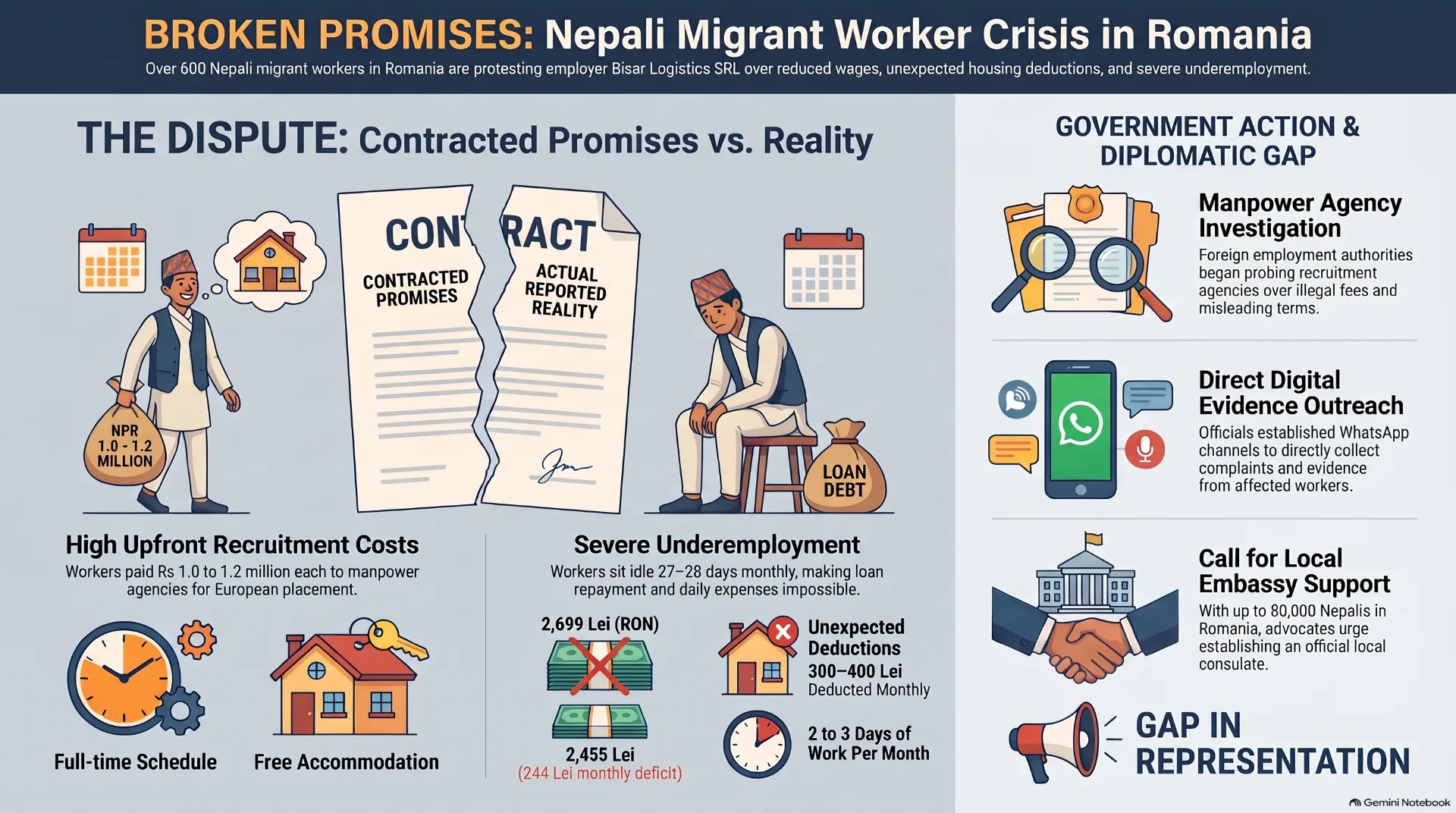
To secure employment in Eastern Europe, migrant workers make immense financial sacrifices long before boarding their flights. Protesting laborers report paying recruitment agencies ("manpower companies") upfront fees ranging between Rs 1 million and Rs 1.2 million (10 to 12 lakh NPR) per person. To afford these exorbitant sums, most borrow heavily from local money lenders at high interest rates, banking on European wages to discharge their debts within their first year of service.
Under normal operational conditions, a foreign worker in Romania earns an average base salary of approximately €600 per month. Mathematically, repaying a 1.2 million NPR loan while covering basic living costs requires steady full-time employment. Upon arrival, however, the promised work schedules collapsed. Laborers report being assigned shifts for barely two to three days per month, remaining forcibly idle in company housing for the remaining 27 to 28 days. When monthly duty is reduced to a fraction of expected capacity, earning €600 becomes impossible, transforming what was meant to be an economic ladder into an inescapable debt trap.
"I came after paying Rs 1.2 million, but they give us duty for only two or three days a month and keep us on leave for the other 27 or 28 days," one protesting worker explained. "We came because we were told there was work at Bisar. After arriving, we got neither the work nor the salary we were promised."
Takeaway 2: The Contract Bait-and-Switch & Hidden Deductions
Beyond the shortage of working hours, the crisis highlights a widespread institutional practice in international labor migration: the post-arrival erosion of contractual wage terms. Before departing Nepal, candidates signed legally binding employment agreements stipulating a basic monthly salary of 2,699 Romanian lei. Upon entry into Romania, workers discovered that their net payouts fell significantly short of these stipulated figures.
The financial pressure intensified when the company began unilaterally deducting 300 to 400 lei per month for housing an amenity previously provided free of charge or understood to be an employer-covered benefit. This administrative shift caused take-home earnings to plunge by Rs 9,000 to Rs 10,000 per month. For low-wage migrant workers who calculate every unit of currency to cover high-interest local debt and essential remittances back home, these structural deductions severely undermine basic economic survival.
Takeaway 3: Economic Slowdown vs. Exploitation The Two Sides of the Narrative
The confrontation at Bisar Logistic SRL a company employing between 600 and 700 total staff, including approximately 400 Nepalis exposes a fundamental tension between worker rights and corporate risk management during economic downturns.
Worker Claims
Employer / Representative Defense
Contractual Breach: The company failed to provide agreed full-time work schedules, baseline monthly salaries of 2,699 lei, and guaranteed contractual benefits.
Macroeconomic Slump: Surendra Gautam (NRNA ICC member) attributes reduced hours to Romania's broader economic slowdown, increased corporate taxes, and winter operational lulls.
Forced Idleness: Shifts have been cut to 2–3 days per month, forcing workers to remain idle in living quarters for 27–28 days without income opportunities.
Wages Not Suspended: The firm maintains it has not halted payroll entirely; as a major employer of 600–700 workers, it must submit tax filings and payment logs to the government.
Unilateral Deductions: Income dropped by Rs 9,000–10,000 monthly due to new post-tax deductions of 300–400 lei for accommodation and utilities.
Cost Recovery: Net salary reductions reflect standard post-tax deductions for housing, electricity, and amenities that the company can no longer fully subsidize.
This clash highlights a persistent dynamic in host-country labor markets: when macroeconomic contractions, tax hikes, or seasonal slumps hit destination markets, corporate entities routinely offload financial risk onto vulnerable foreign workforces through reduced hours and restructured benefit schemes.
Takeaway 4: The "Diplomatic Ghost Town"80,000 Workers Managed from another Country
The protests in Romania reveal a dangerous institutional deficit in state protection. Official government figures account for roughly 50,000 to 55,000 Nepali residents in Romania, but local community estimates put the actual population between 75,000 and 80,000.
Despite this expanding footprint, Nepal maintains no resident embassy or consular mission in Bucharest. All diplomatic, administrative, and legal affairs are managed remotely via the Nepali Embassy in Berlin, Germany hundreds of miles away.
Demographic Reality: 75,000 to 80,000 Nepali workers residing across Romania.
Institutional Void: Zero local consular presence; diplomatic coverage outsourced to Berlin.
Information Disconnect: When protests erupted, the Nepali Embassy in Berlin acknowledged it had no initial information regarding the demonstrations or the stranded workers' grievances.
Heightened Risk Profile: Romanian employers frequently expect foreign laborers to work longer hours than local citizens while navigating complex legal paperwork, exposing unrepresented migrants to heightened regulatory and occupational risks.
Severe Human Cost: As worker populations grow without state infrastructure, cases of sudden death, disappearance, and suicide have escalated. Deprived of official consular aid, local migrant communities are forced to launch private fundraising drives simply to repatriate the bodies of deceased compatriots back to Nepal.
When rapid labor exportation outpaces state diplomatic infrastructure, workers are left operating in a legal vacuum where basic assistance becomes inaccessible during acute crises.
Takeaway 5: A Digital Response Government Investigation via WhatsApp
Faced with escalating public demonstrations and media coverage, Nepal's state apparatus responded through unconventional emergency channels. The Ministry of Labour, Employment and Social Security, alongside the Department of Foreign Employment, established direct lines of communication with stranded workers in Romania using WhatsApp and digital messaging platforms to record grievances and compile evidence.
Simultaneously, regulatory authorities in Kathmandu initiated formal investigations into recruitment agencies ("manpower companies") responsible for dispatching workers to Bisar Logistic SRL. Government officials issued formal warnings of legal prosecution against agencies engaging in:
Charging illegal, inflated recruitment fees beyond statutory caps.
Disseminating false or misleading information regarding overseas job conditions.
Applying coercive pressure on candidates or committing contract fraud prior to departure.
While direct WhatsApp outreach demonstrates commendable digital responsiveness, relying on messaging applications during an active crisis highlights the absence of proactive regulatory oversight at origin points. Regulating recruitment agencies after workers have taken on life-altering debt and landed in vulnerable overseas conditions offers little immediate relief to those already stranded.
Conclusion: Looking Ahead
The operational breakdown at Bisar Logistic SRL illustrates the systemic vulnerabilities embedded across the global labor supply chain. When recruitment transparency is unaligned with market realities, when destination-country economic contractions are passed directly to foreign staff, and when origin-country diplomatic support lags behind export volumes, foreign laborers pay the ultimate price. Sustained reform requires rigorous regulation of recruitment brokers at origin, mandatory bilateral oversight in host nations, and robust, physically present diplomatic infrastructure where major worker populations reside.
As thousands of hopeful individuals continue to mortgage their financial futures to pursue employment in Europe, this incident forces a critical re-examination of international labor norms: How can origin and host governments establish enforceable frameworks that prevent the pursuit of global economic opportunity from turning into an insurmountable trap of debt and displacement?