
Why Sending 1 Worker to Europe Beats 3 to the Gulf: 4 Counter-Intuitive Truths About Nepal’s Foreign Employment Crisis
11/15/2026
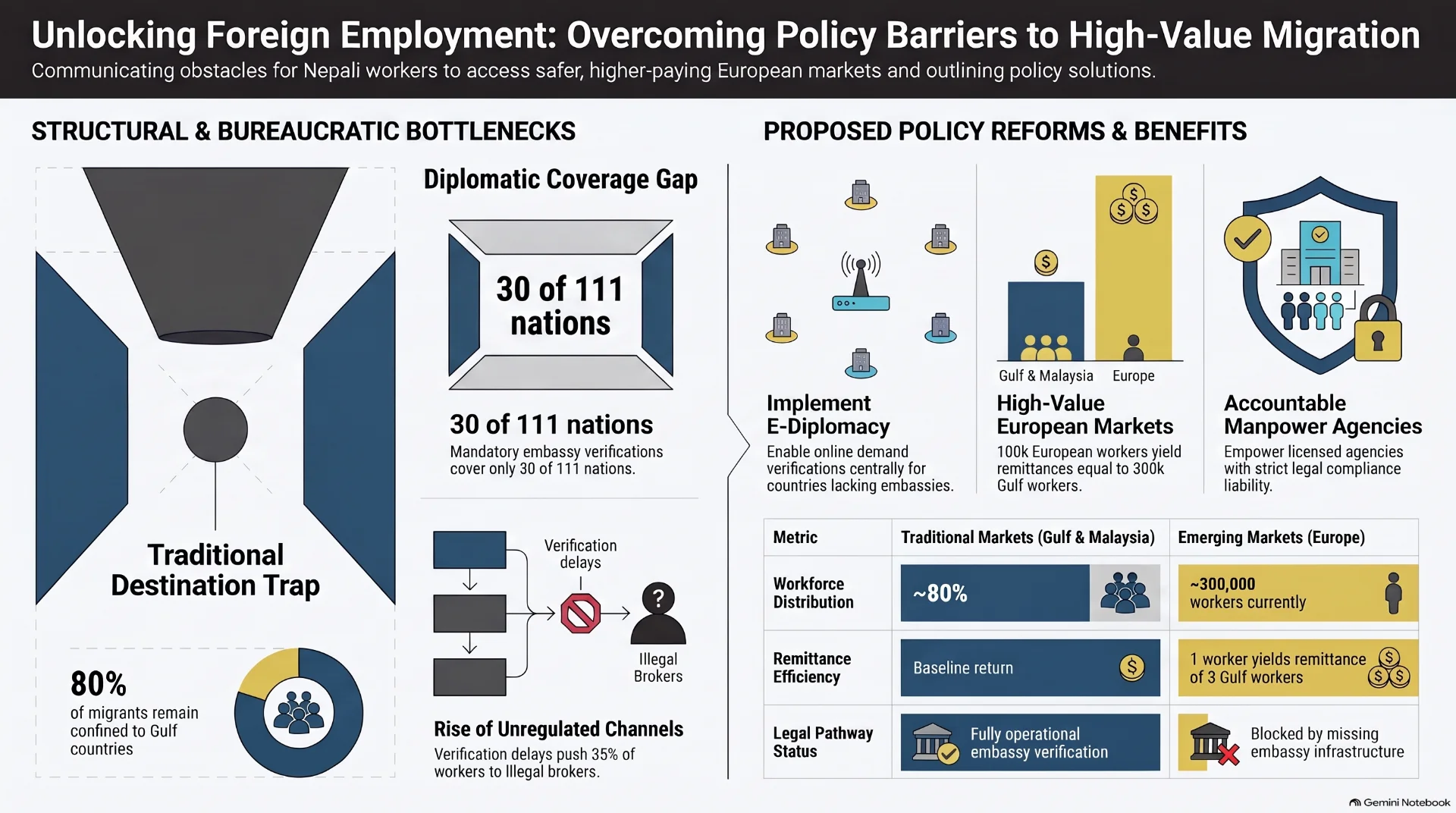
Foreign employment serves as the macroeconomic bedrock of Nepal, yet for three decades, its national labor migration model has remained rigidly anchored to low-wage corridors. Between 80% and 90% of Nepalese migrant workers remain concentrated in Malaysia and the Gulf states, leaving the country's remittance-dependent economy dangerously exposed to asymmetric regional shocks. This structural vulnerability is not the result of shifting global labor demand, but rather a consequence of state-induced market distortion and systemic diplomatic bottlenecks that suppress access to high-value international markets.
The 1:3 Remittance Math: Why Europe Outweighs the Gulf
From a global mobility perspective, maintaining a labor pipeline that funnels hundreds of thousands of workers into depressed wage environments represents a gross human capital misallocation. Emerging European destinations offer base salaries two to three times higher than traditional Gulf contracts, fundamentally altering the economics of labor export. Under this structural dynamic, placing 100,000 workers in European nations achieves remittance yield optimization equal to deploying 300,000 workers to the Gulf.
Already, an estimated 300,000 Nepalese workers have navigated their way into roughly 40 European nations across the Schengen area, Eastern Europe, and the Balkans with Romania alone absorbing 33,000 Nepalese workers in the past year. Beyond raw cash inflows, these advanced labor destinations offer structural protections, including enforceable human rights guarantees, institutional workplace safety, and exposure to advanced economic ecosystems.
Rajendra Bhandari, Former President of the Nepal Foreign Employment Entrepreneurs Association (NAFEA), outlines this quantitative disparity:
"If we send 300,000 people to the Gulf countries, let us send only 100,000 to Europe. Salaries in Europe are double or triple those in the Gulf. 100,000 people will send remittance equivalent to 300,000."
Persisting with low-margin migration corridors needlessly caps the country's macroeconomic potential while inflating national exposure to geopolitical instability in a single geographic zone.
The Bureaucratic Catch-22 Promoting Illegal Middlemen
This failure to capitalize on higher-yield markets stems directly from a legislative paradox within Nepal’s Foreign Employment Act. While the government has formally cleared 111 sovereign states for institutional labor placement and Nepalese workers have independently reached nearly 180 countries Nepal maintains diplomatic embassies in only 28 to 30 of these jurisdictions.
Because the governing statute mandates physical demand letter verification by a local Nepalese embassy prior to institutional recruitment, licensed agencies are legally barred from operating in roughly 150 authorized destinations. This administrative wall has created a massive regulatory arbitrage opportunity for shadow networks. Unregulated brokers and human smugglers exploit visit visas and informal settings, driving approximately 35% of all outward labor flows into precarious, unmonitored pathways.
This bureaucratic obstruction is particularly perverse given state fiscal mechanics. Licensed manpower agencies deposit substantial financial collateral (धरौटी) with the government to operate and assume legal risk, yet state machinery routinely limits these accountable actors while turning a blind eye to predatory recruitment syndicates such as those operating in Malaysia.
Historical precedent illustrates this regulatory backsliding: the Ministry of Labor previously introduced a rule permitting online demand letter verification for countries lacking diplomatic representation. Under this framework, recruitment agencies legally placed 4,000 to 5,000 workers in European nations like Romania while generating legitimate state revenue. Rather than expanding this success, the government retroactively repealed the regulation, effectively forcing migration back into illegal channels.
As Bhandari candidly highlights:
"People have reached 180 countries, but the legal path is limited to only 30 countries. Government policy is promoting middlemen, brokers, and smugglers to send people."
Government Double Standards and Inter-Ministerial Friction
The failure to transition toward high-yield labor markets is further exacerbated by acute inter-ministerial friction between the Ministry of Labor and the Ministry of Foreign Affairs. While labor authorities periodically attempt to modernize recruitment structures, diplomatic missions and foreign ministry officials remain entrenched in bureaucratic conservatism, procedural stalling, and legacy protocols.
This institutional misalignment produces profound policy contradictions. The Nepalese government has negotiated formal, bilateral labor agreements with European nations including Germany, Spain, and Romania where worker protections are contractually guaranteed at the state level. Yet, Nepal’s own diplomatic missions frequently refuse to verify corporate demand letters from these identical countries, citing chronic resource constraints or speculative fears that workers might abscond across Schengen borders. In high-value Asian markets like Japan, embassy personnel have halted demand verification procedures altogether under the banner of inadequate staffing.
Bhandari underscores the absurdity of this diplomatic sabotage:
"Labor agreements are signed with countries where worker safety is guaranteed by the state level... but embassy officials do not verify demands even for those countries. This is a complete contradiction."
Signing international labor compacts only to have the nation's own diplomatic corps suppress their execution exposes a systemic paralysis at the core of Nepal's foreign policy apparatus.
Foreign Employment Delivers "Skill Remittances," Not Just Cash
A persistent counter-argument within diplomatic circles is that Nepalese labor lacks the technical sophistication required for advanced European economies. Macroeconomic reality refutes this premise: market access itself serves as the primary catalyst for human capital development. When lucrative mobility corridors open, prospective workers proactively invest in targeted trade qualifications and skill acquisition.
Moreover, modern labor migration generates substantial "skill remittances" that accelerate domestic economic transformation. Historical precedents validate this transfer mechanism: returnees from Israel introduced advanced precision agricultural techniques and "tunnel farming" that modernized domestic crop yields. In today's hyper-connected economy where Nepalese IT specialists routinely manage U.S. technology infrastructure remotely from Kathmandu workers returning from European and Western markets will re-enter the domestic economy with hands-on expertise in robotics, automation, and artificial intelligence.
To unlock this potential, Nepal must overhaul its regulatory architecture by deploying a modernized "E-Diplomacy" framework. Under this system, the Ministry of Foreign Affairs would execute direct online demand verification for all destinations lacking physical embassies.
To mitigate state risk, Bhandari proposes a pragmatic policy execution model: a 6-month to 1-year pilot testing period. During this trial run, licensed recruitment agencies who maintain mandatory financial collateral (धरौटी) with the government would assume strict legal and financial liability for contract enforcement, minimum wage guarantees, and worker safety. If an agency fails to protect a worker, statutory penalties and financial forfeitures would be automatically enforced.
Re-conceptualizing foreign employment as a strategic engine for technology transfer converts labor migration from a passive relief valve for domestic unemployment into a proactive instrument of national development.
Conclusion: A Call for Modernization
Nepal stands at a decisive economic crossroad. Persisting with a 30-year-old migration model that funnels workers predominantly into low-wage, high-vulnerability corridors systematically undercounts the economic value of the nation's workforce and leaves the broader economy exposed to external shocks.
The structural path forward demands replacing administrative inertia with modern, technology-driven governance. By institutionalizing E-Diplomacy, operationalizing a structured pilot testing program for emerging markets, and holding licensed agencies accountable through existing financial collateral mechanisms, Nepal can safely expand its global labor footprint.
Will Nepal continue to trap its workforce in outdated migration loops out of administrative inertia and diplomatic fear, or will it embrace E-Diplomacy and private sector accountability to unlock safe, high-value opportunities worldwide?